Reviewed August 2012

Charles Stuart, GCB, PC, GCTS (1779-1845)
1st Baron Stuart of Rothesay (cr. 1828) and Count of Machico (1825) and Marquess of Angra do Heroismo, in Portugal.
For his portrait in fine robes when he was Ambassador to France see, http://www.gac.culture.gov.uk/search/Object.asp?object_key=29014
The son of Lieut.-General Sir Charles Chrichton-Stuart, KB, who commanded a batallion of the 37th Regiment of Foot during the War of the American Revolution, and grandson of John Stuart, KG, 3rd Earl of Bute. His mother was Lady Anne Louisa Bertie, daughter of Lord Vere Bertie.
Lord Stuart of Rothesay married Lady Elizabeth Margaret Yorke, daughter of the 3rd Earl of Hardwicke and had two daughters.
Minister at the Hague (1815), Ambassador to France (1815-24 and 1828-30), Envoy to Portugal (1810), Ambassador to St. Petersburg (1841-45), Ambassador to Portugal (1825-26) and a member of the Regency of Portugal during the Peninsular Wars.
In 1823, acting as a mediator, he was sent as an Ambassador of King John VI of Portugal to Brazil to negotiate the independence and on behalf of George Canning, to assure a new trade agreement with the Empire of Brazil favourable to British interests.
Later, after John VI's death in 1826, he went again to Brazil and brought to Portugal the Constitutional Chart given by the new king Dom Pedro IV together with his abdication on his daughter Mary who was to marry her uncle D. Miguel, the ultras leader, then in exile in Austria.
This however did not settle the dynastic dispute, since his younger brother Dom Miguel was acclaimed king in 1828, giving rise to a civil war- known to British authors as the 'War of the Two Brothers' - which lasted till 1834.
He was awarded the Grand Cross of the Order of the Tower and of the Sword in 1812.
Lord Stuart of Rothesay fullfilled his life dream of reacquring his grandfather's estate - Highcliffe - and built a new house - Highcliffe Castle , Hampshire, in the Gothic revival style.
For his earlier house - Bure Homage see, http://www.users.freenetname.co.uk/~bgwells/BAEXCHSite/xchsite.htm

His library, like so many others, was sold in an auction in London in 1855, of which a Catalogue was printed.
Fortunately enough, two XIXth century well-knonw Portuguese bibliophiles bought many books at the auction of Sir Charles Stuart of Rothesay's Library, in 1855: the Count of Lavradio and Mr. João da Guerra Rebelo Fontoura, a wine merchant in London. The latter was married 2ndly, to Cecilia Eleanor Canning. Both these libraries were in turn later dispersed at auction sales, Fontoura's having been sold in Leipzig, by Mssrs. Karl W. Hiersemann, in 1899 (cf. Luís de Bivar Guerra, «A biblioteca de Lord Stuart de Rothesay núcleo de duas importantes livrarias portuguesas», pp. 120-123).
Lord Stuart of Rothesay also used another superlibros (a crest with motto) on the bindings of his books (see, example from a book at St. John's College, Cambridge -http://www.joh.cam.ac.uk/library/special_collections/early_books/pix/provenance/stuart/stuart.htm)
Part of his papers with important correspondance have left Europe and are at the Andersen Library, University of Minnesota (see, http://special.lib.umn.edu/findaid/xml/mss024.xml) and at Lilly Library (see, http://www.indiana.edu/~liblilly/lilly/mss/html/stuart.html). An important collection of maps his at the Univ. of California, Los Angeles (see, http://ark.cdlib.org/ark:/13030/tf3p300592/)
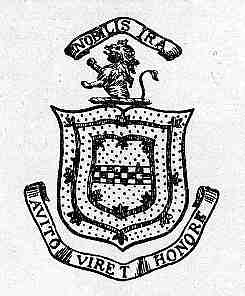
Lord Stuart used in his books bindings a superlibros described below.
Arms: Stuart of Rothesay
Motto: «Avito Viret Honor», «Nobilis Ira»

Charles Stuart, GCB, PC, GCTS (1779-1845)
1st Baron Stuart of Rothesay (cr. 1828) and Count of Machico (1825) and Marquess of Angra do Heroismo, in Portugal.
For his portrait in fine robes when he was Ambassador to France see, http://www.gac.culture.gov.uk/search/Object.asp?object_key=29014
The son of Lieut.-General Sir Charles Chrichton-Stuart, KB, who commanded a batallion of the 37th Regiment of Foot during the War of the American Revolution, and grandson of John Stuart, KG, 3rd Earl of Bute. His mother was Lady Anne Louisa Bertie, daughter of Lord Vere Bertie.
Lord Stuart of Rothesay married Lady Elizabeth Margaret Yorke, daughter of the 3rd Earl of Hardwicke and had two daughters.
Minister at the Hague (1815), Ambassador to France (1815-24 and 1828-30), Envoy to Portugal (1810), Ambassador to St. Petersburg (1841-45), Ambassador to Portugal (1825-26) and a member of the Regency of Portugal during the Peninsular Wars.
In 1823, acting as a mediator, he was sent as an Ambassador of King John VI of Portugal to Brazil to negotiate the independence and on behalf of George Canning, to assure a new trade agreement with the Empire of Brazil favourable to British interests.
Later, after John VI's death in 1826, he went again to Brazil and brought to Portugal the Constitutional Chart given by the new king Dom Pedro IV together with his abdication on his daughter Mary who was to marry her uncle D. Miguel, the ultras leader, then in exile in Austria.
This however did not settle the dynastic dispute, since his younger brother Dom Miguel was acclaimed king in 1828, giving rise to a civil war- known to British authors as the 'War of the Two Brothers' - which lasted till 1834.
He was awarded the Grand Cross of the Order of the Tower and of the Sword in 1812.
Lord Stuart of Rothesay fullfilled his life dream of reacquring his grandfather's estate - Highcliffe - and built a new house - Highcliffe Castle , Hampshire, in the Gothic revival style.
For his earlier house - Bure Homage see, http://www.users.freenetname.co.uk/~bgwells/BAEXCHSite/xchsite.htm
His library, like so many others, was sold in an auction in London in 1855, of which a Catalogue was printed.
Fortunately enough, two XIXth century well-knonw Portuguese bibliophiles bought many books at the auction of Sir Charles Stuart of Rothesay's Library, in 1855: the Count of Lavradio and Mr. João da Guerra Rebelo Fontoura, a wine merchant in London. The latter was married 2ndly, to Cecilia Eleanor Canning. Both these libraries were in turn later dispersed at auction sales, Fontoura's having been sold in Leipzig, by Mssrs. Karl W. Hiersemann, in 1899 (cf. Luís de Bivar Guerra, «A biblioteca de Lord Stuart de Rothesay núcleo de duas importantes livrarias portuguesas», pp. 120-123).
Lord Stuart of Rothesay also used another superlibros (a crest with motto) on the bindings of his books (see, example from a book at St. John's College, Cambridge -http://www.joh.cam.ac.uk/library/special_collections/early_books/pix/provenance/stuart/stuart.htm)
Part of his papers with important correspondance have left Europe and are at the Andersen Library, University of Minnesota (see, http://special.lib.umn.edu/findaid/xml/mss024.xml) and at Lilly Library (see, http://www.indiana.edu/~liblilly/lilly/mss/html/stuart.html). An important collection of maps his at the Univ. of California, Los Angeles (see, http://ark.cdlib.org/ark:/13030/tf3p300592/)
Lord Stuart used in his books bindings a superlibros described below.
Arms: Stuart of Rothesay
Motto: «Avito Viret Honor», «Nobilis Ira»


