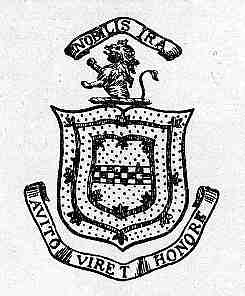
Richard Sealy, Esq. Lisbon
Superlibros of Lord Charles Stuart of Rothesay
Charles Stuart, GCB, PC, GCTS (1779-1845)
1st Baron Stuart of Rothesay (cr. 1828) and Count of Machico (1825) and Marquess of Angra do Heroismo, in Portugal.
For his portrait in fine robes when he was Ambassador to France see, http://www.gac.culture.gov.uk/search/Object.asp?object_key=29014
The son of Lieut.-General Sir Charles Chrichton-Stuart, KB, who commanded a batallion of the 37th Regiment of Foot during the War of the American Revolution, and grandson of John Stuart, KG, 3rd Earl of Bute. His mother was Lady Anne Louisa Bertie, daughter of Lord Vere Bertie.
Lord Stuart of Rothesay married Lady Elizabeth Margaret Yorke, daughter of the 3rd Earl of Hardwicke and had two daughters.
Minister at the Hague (1815), Ambassador to France (1815-24 and 1828-30), Envoy to Portugal (1810), Ambassador to St. Petersburg (1841-45), Ambassador to Portugal (1825-26) and a member of the Regency of Portugal during the Peninsular Wars.
In 1823, acting as a mediator, he was sent as an Ambassador of King John VI of Portugal to Brazil to negotiate the independence and on behalf of George Canning, to assure a new trade agreement with the Empire of Brazil favourable to British interests.
Later, after John VI's death in 1826, he went again to Brazil and brought to Portugal the Constitutional Chart given by the new king Dom Pedro IV together with his abdication on his daughter Mary who was to marry her uncle D. Miguel, the ultras leader, then in exile in Austria.
This however did not settle the dynastic dispute, since his younger brother Dom Miguel was acclaimed king in 1828, giving rise to a civil war- known to British authors as the 'War of the Two Brothers' - which lasted till 1834.
He was awarded the Grand Cross of the Order of the Tower and of the Sword in 1812.
Lord Stuart of Rothesay fullfilled his life dream of reacquring his grandfather's estate - Highcliffe - and built a new house - Highcliffe Castle , Hampshire, in the Gothic revival style.
For his earlier house - Bure Homage see, http://www.users.freenetname.co.uk/~bgwells/BAEXCHSite/xchsite.htm

His library, like so many others, was sold in an auction in London in 1855, of which a Catalogue was printed.
Fortunately enough, two XIXth century well-knonw Portuguese bibliophiles bought many books at the auction of Sir Charles Stuart of Rothesay's Library, in 1855: the Count of Lavradio and Mr. João da Guerra Rebelo Fontoura, a wine merchant in London. The latter was married 2ndly, to Cecilia Eleanor Canning. Both these libraries were in turn later dispersed at auction sales, Fontoura's having been sold in Leipzig, by Mssrs. Karl W. Hiersemann, in 1899 (cf. Luís de Bivar Guerra, «A biblioteca de Lord Stuart de Rothesay núcleo de duas importantes livrarias portuguesas», pp. 120-123).
Lord Stuart of Rothesay also used another superlibros (a crest with motto) on the bindings of his books (see, example from a book at St. John's College, Cambridge -http://www.joh.cam.ac.uk/library/special_collections/early_books/pix/provenance/stuart/stuart.htm)
Part of his papers with important correspondance have left Europe and are at the Andersen Library, University of Minnesota (see, http://special.lib.umn.edu/findaid/xml/mss024.xml) and at Lilly Library (see, http://www.indiana.edu/~liblilly/lilly/mss/html/stuart.html). An important collection of maps his at the Univ. of California, Los Angeles (see, http://ark.cdlib.org/ark:/13030/tf3p300592/)
Lord Stuart used in his books bindings a superlibros described below.
Arms: Stuart of Rothesay
Motto: «Avito Viret Honor», «Nobilis Ira»
John Peter Hornung
The Bulwer-Lytton Bookplates

British Ambassador to Turkey. The son of General William Earl Bulwer (1757 – 1807), of Heydon Hall, Norfolk, Colonel of the 108th Regiment known as Norfolk Rangers, and Elizabeth Barbara Warburton-Lytton (1798 – 1843)dau. of Richard Warburton-Lytton (1745-1843), of Knebworth House, in Hertfordshire.
He m. Emily Gascoyne dau. of General Gascoyne.
F. 4330
A shield encircled by a garter bearing the motto, with a helmet and crest above.
Arms: gules on a chevron argent between three eagles close reguardant or as many cinquefoils sable [Bulwer].
Crest: a horned wolf’s head erased.
Motto: Adversis major, par secundis
He used another armorial bookplate (F. 4329) bearing Bulwer quartering Earle, Wiggett and Lytton, (J. Warwick, 145 Strand).
He had two famous brothers:
(William) Henry Lytton Earle Bulwer, 1st Baron Dalling and Bulwer, GCB, PC (1801–1872) was a British Liberal politician, diplomat and writer.
A protégé of Lord Palmerston he was successively attaché at Berlin 1827, Vienna 1829, The Hague 1830 and at Paris 1832-33; then he was elected M.P. for Wilton 1830, Coventry 1831-35 and Marylebone 1835-37. Again in the diplomatic service he was Chargé d'affaires, Brussels, 1835-37, Secretary of embassy at Constantinople1837-38, Secretary of embassy at Paris, 1839-43, Minister-Plenipotentiary and Envoy-Extra-ordinary at Madrid, 1843-48, at Washington, 1849-52 and at Florence, 1852-55.
And the youngest, Lord Edward George Earle Bulwer-Lytton (1803-1873), novelist, poet, playwright, and politician, 1st Baron Lytton of Knebworth.
The latter's son also had a bookplate:

Lord Edward Robert Bulwer Lytton (1831-1891) 2nd Baron Lytton, 1st. Earl of Lytton
Diplomat and writer, also known as Owen Meredith.
Lord Robert Lytton married Edith Villiers (1841-1936), dau. of Edward Villiers and Elizabeth Liddell, Lady-in-Waiting to Queens Victoria and Alexandra and niece of Lord Clarendon.
Lord Lytton in 1866 was secretary of the British Legation in Lisbon where he returned in 1874 as Minister. From 1876 to 1880 he was Viceroy and Governor-General of India appointed by Disraeli and in 1887 was appointed British Ambassador to France till his death in 1891.
Sir Charles James Fox Bunbury, 8th Baronet

F. 4334
Arms: Bunbury quartering Hanmer, North and ......, impaling Horner.
Motto: Esse Quam Videri
This bookplate was most probably made after Sir Charles succeeded his father in the Baronetcy, in 1860.
He was the son of Lt.-Gen. Sir Henry Edward Bunbury, (1778-1860), 7th Bt. and Louisa Emilia Fox dau. of General the Hon. Henry Edward Fox (1771-1811) who was the younger brother of Charles James Fox.
His aunt Caroline Amelia Fox was m. to Lt.-Gen. Sir William Francis Patrick Napier, who fought in the Peninsular War and wrote History of the war in the peninsula and in the south of France : from the year 1807 to the year 1814. His brother was Lieut. General Sir George Thomas Napier (1784-1855), also a veteran from the Peninsular War and Commander-in-Chief of the Army in the Cape Colony.
He married Frances Joanna Horner, daughter of Leonard Horner, on 31 May 1844 whose elder sister Mary Horner was married to the geologist Charles Lyell.
A famous botanist and plant collector, accompanied Lieutenant-General Sir George Napier to Cape of Good Hope in 1837, elected to the Royal Society in 1851, author of numerous papers on Geographical Botany and on Fossil Plants.
Published Journal of a Residence at the Cape of Good Hope in 1848; and Botanical Fragments in 1883, botanical observations made in South Africa & South America. His wife published Life, Letters, and Journals of Sir Charles J.F. Bunbury, Bart., edited by Frances Joanna Bunbury, 3 vols., London 1894.
In 1833-35 he visited Argentina Uruguay and Brazil travelling from from Rio de Janeiro to Minas Gerais where his uncle Henry Fox - an amateur botanist - was H.M. Minister (see, Sir Charles James Fox Bunbury, Brazil, Account of a Journey in Brazil in 1833-35, and Portuguese translation, Narrativa de viagem de um naturalista ingles ao Rio de Janeiro e Minas Gerais, 1833-35, Imprensa Nacional: Rio de Janeiro, 1943).
In 1853-54 he travelled to Madeira where he also collected a herbarium.
Sir Charles brother, who would succeed him as the 8th Bart., Sir Edward Herbert Bunbury was also a member of parliament, a well known geographer and archaeologist, and author of a History of Ancient Geography. Their younger brother Colonel Henry William St Pierre Bunbury, soldier, author and politician and an explorer in Western Australia.
Another bookplate is known to have been used by Sir Charles bearing the Bunbury crest but not reported by in the Frank’s collection.

See also F. 4336 F. 4337 – Bookplates of his father Lt.-General Sir Henry Edward Bunbury, 7th Bart, with different arms, the first Bunbury impalling Fox and the second made after his 2nd m. (1830) to Emily Louisa Napier, Bunbury impalling Napier quartering Scot.
Col. Hugh OWEN (1784-1861)
Major Hugh Owen of the 7th & 18th Hussars, Macphail lith., 1849 He served in the Peninsular War, arriving in Portugal in 1809, as a Lieutenant of the 16th Light Dragoons Regiment, under the command of Lord Cambermere. He was present at Albergaria, Grijó and in the pursuit of the French Army under Marshall Soult on their flight to Salamonde.
At the battle of Talavera he commanded the united skirmishers of the 14th, 16th and 23rd Light Dragoons and of the 1st German Hussars of the 2nd Cavalry Brigade under the command of Brigadier General Stapleton Cotton.
In 1810 was promoted a Captain of the Portuguese Army by Marshall Beresford serving as Aide-de-Camp of General Fane commander of a Brigade attached to the Hill Division on the retreat to the Lines of Torres Vedras and operations thereafter.
As a Major, he then served as aide de camp of General Benjamin d’Urban, commander of the Portuguese Cavalry Brigade.
At the battle of Vitória he commanded the cavalry charge that ended French resistance, having attracted the attention of Lord Wellington.
At the end of the war, in 1815, Owen entered the service of the Portuguese Army as a Lieutenant Colonel of the 6th Chaves Dragoons Regiment.
But, by this time the 1820 Revolution had taken place and the Provisional Junta had dismissed Marshall Sir William Beresford and all British Officers in the Portuguese Army.
For his services during the Peninsular War he was made a Knight of the Order of the Tower and Sword and a Commander of the Order of St. Benedict of Avis. Awarded also the Army Gold Cross and the Peninsular Military General Service Medal with 4 clasps for Talavera, Albuera, Vittoria and Pyrenees and three Spanish medals.
In 1832, at the start of the Civil War he lived at Oporto then taken by the troops led by D. Pedro, duke of Braganza who immediately invited him the command the Cavalry as a General. Col. Owen refused being a British citizen and obeying the instructions from H.M. Government. But during the siege of Oporto by D. Miguel’s army he gave his collaboration to D. Pedro.
He published his memoirs of that period - The Civil War in Portugal: And the Siege of Oporto, London, E. Moxon, 1836, of which there was a Portuguese edition - O Cerco do Porto contado por uma Testemunha - O Coronel Owen, Porto 1915.
In 1856 he returned to Britain leaving behind his wife and children.

In his bookplate Colonel Hugh Owen bears pending from his arms the insignia of the Order of the Tower and Sword and its motto - «Valor e Lealdade». In the first and second quarters his other medals are shown.
Major-General Sir Robert John HARVEY
Major-General Sir Robert John HARVEY, CB, KTS, FRS, FAS (1785-1860), of Mousehold House, Norwich
The son of John Harvey, Esq,, of Thorpe Lodge, Norfolk and Frances Kerrinson, daughter of Sir Roger Kerrinson, of Brooke House. In 1815, he married his distant cousin Charlotte Mary, dau. of Robert Harvey, Esq., of Watton.
In the expedition sent to Portugal in March 1809, under the command of Major-General Lord Hill, he served as a Captain of the 53rd Foot Regiment. In 1810, he was made a Major and appointed Assistant-Quarter-Master-General of the Portuguese Army attached to the Headquarters of the Portuguese Army’s Commander-in-Chief - Marshall William Carr Beresford. In 1811, Beresford appointed him to General-Headquarters of Marshall Lord Wellington – Commander-in-Chief of the Allied Forces, as a liaison Officer with the Portuguese troops in the field and as Chief of the Staff of the Portuguese Army, in his absence. He remained in this position till the end of the war in 1814[1].
During the first years of the War his services were particularly relevant in organizing nine Portuguese Guerrilla Corps, the Ordenanças and in intelligence services[2] owing to his superior linguist abilities and perfect domain of the French and German languages.
He was present namely, at the battles of Oporto, Buçaco, Salamanca, Vitoria, Pyrenees, Nive, Nivelle, Orthez, Toulouse and in the sieges of Ciudad Rodrigo, Burgos, Badajoz and San Sebastian. After the capture of Badajoz (April 1812) Harvey was made a Lieutenant-Colonel in the Portuguese Army. After Salamanca and Vitória, Harvey was promoted a Lieutenant-Colonel in the British Army, on the recommendation of Lord Wellington.
For his distinguished services in the Peninsular War he was made by the King of Portugal a knight of the Order of the Tower and Sword (British Royal Warrant of May 1816). The Prince Regent awarded him a knighthood, in February, 6th, 1817, [3] and in 1831 he was made a Companion of the Order of the Bath.
In an engraved portrait of 1821, by Charles Knight, he proudly bears his Portuguese decorations – the Peninsular War Campaign Cross (6 campaigns), the insignia of a Knight of the Order of the Tower and Sword and the rare Commander’s Medal of the Peninsular War (10 campaigns) -, and the Army Gold Medal (Orthez). The absence of the insignia of the order of Avis means that the award was made after that date, also for services in the Peninsular War.
The bookplate bears the arms of Harvey of Thorpe with Harvey on an escutcheon[4], with several augmentations of honour:
Arms: Erminois on a chief indented gules between two crescents argent, the Army Gold Medal awarded by the Prince Regent for his services at the Battle of Orthes, a canton ermine charged with the badge of a Knight of the Order of the Tower and Sword[5].
Crest: Over a dexter cubit arm, erect, ppr., a crescent arg. between two branches of laurel also ppr., with the augmentation of a mural crown or, out of which the arm is issuant.
Motto: Alteri si Tibi.
The bookplate also shows the badge of the Order of the Tower and Sword pending with a ribbon from the shield, which only occurs with few British recipients of the Order, founded in Brazil in 1808. It proves how highly Sir Robert John Harvey esteemed this award.
Sir Robert J. Harvey used yet another armorial bookplate in stencil, bearing also pending from the shield the cross of the Order of Avis of which he was a knight commander[6].
According to the Catalogue of the Franks Collection of Bookplates, Sir Robert Harvey’s father – John Harvey, Esq. also used an armorial spade shield bookplate with Harvey impalling Kerrinson [7].
Thanks are due to our good friend Paulo Estrela for his valuable help in clarifying Sir Robert J. Harvey’s Peninsular War decorations and in calling our attention to the fact that those decorations were sadly dispersed, sold in auctions namely, at Christie’s (24.04.92) and at Spink’s (25.09.01).
____________
Notes:
[1] For a more detailed account of his military career, namely in the Peninsular War see, the Obituary published in «The Gentleman's Magazine», London, 1860, pp. 191-193
[2] H G Hart, Hart's Annual Army List, Militia List, and Imperial Yeomanry List, J. Murray, 1845, p. 26
[3] Francis Townsend, Calendar of Knights: Containing Lists of Knights Bachelors, British Knights of Foreign Orders ..., W. Pickering, 1828, pp. 30 and 92
[4] See, Franks Collection Catalogue, # 14013, vol. 2, p. 29.
[5] John Burke & John Bernard Burke, The Knightage of Great Britain and Ireland, London, 1841, pp. 169-170 and Burke's Genealogical and Heraldic History of the Landed Gentry, Vol 1, London, Henry Colburn, 1847, p. 544
[6] John Blatchly, Elegant Economy: the stencilled ex-libris, in «The Bookplate Journal», Vol. 4, #1, March 2006, p.37; referring the Order of Avis, see, Hart’s, ibidem, p. 471
[7] Ibidem, # 14002
Rear-Admiral Thomas Western

He was the second son of Thomas Western (1735 -1781), of Walcot Church, Bath and of Jane Calvert. Married Mary Burch (1777 – 1856), born in Bermudas, West Indies.
The trophy armorial bookplate bears the badge of the Order of the Tower and Sword pending from the shield (badly represented since the star should have seven rays).
During the Portuguese Royal Family voyage to Brazil, avoiding Napoleon’s invading troops, escorted by a Squadron of the British Royal Navy, under the command of Commodore Moore, the then Captain T. Western commanded H.M.S. London.
On December 17th, 1808, on the Queen’s birthday, the Prince Regent Dom João granted Captain Western the class of Commander of the newly reinstituted Order of the Tower and Sword.
According to Francis Townsend, Rear-Admiral Thomas Western only received the Royal Licence to accept the decoration on August, 26th, 1814, few months before he died[i].
See, the Order of the Tower and Sword – II Centenary (1808 – 2008)
*
Contra-Almirante Thomas WESTERN (1761-1814), de Tattingston Place, co. Suffolk, propriedade herdada em 1808 de Thomas White primo de seu pai.
Filho segundogénito de Thomas WESTERN (1735-1781) de Walcot Church, Bath e de Jane CALVERT. Foi casado com Mary BURCH (1777-1856) n. nas Bermudas, Índias Orientais.
O ex-líbris com as armas do titular, e rodeado de troféus, ostenta as insígnias da Ordem de Torre e Espada (mal representadas, uma vez que a placa deveria ter uma estrela de seis raios).
O então Capitão Thomas Western comandava o navio «London», que integrava a esquadra Inglesa, sob o comando do Comodoro Moore, que escoltou a Família Real na sua viagem para o Brasil.
Recebeu a Ordem da Torre e Espada, no grau de comendador, em 17 de Dezembro de 1808.
Ver A ordem da Torre e Espada – II Centenário (1808 – 2008)
________________
Bibliography:
Paul Latchan, Bookplates in the Trophy Style, London, The Bookplate Society, 2006, plate #244, p 158.
___________
[i] Cf. Calendar of Knights: Containing Lists of Knights Bachelors, British Knights of Foreign Orders ...: London, W. Pickering, 1826
Sir Rutherford Alcock's Bookplate (Reviewed)
Sir Rutherford Alcock, K.C.B., D.C.L.,F.R.G.S. (1809-1897)
After the death fo King John VI, in 1826, Portugal was ravaged by a Civil War between (1828-1834) opposing the proclaimed King, Dom Miguel I and the Liberals, led by Dom Pedro, duke fo Braganza, former Emperor of Brazil and for a short while King of Portugal. Dom Pedro gave a Constitutional Chart to the nation and abdicated the crown on his daughter D. Maria II, backed by Great Britain with the condition that she should marry his younger brother D. Miguel then exiled in Vienna. The prince at first complied and swore the new Constitution, but soon after with the support of the conservative forces called the ancient Cortes and was proclaimed King. The Liberals were prosecuted, emprisoned, some executed and others fled into exile, mainly to England.

Engraving by Daumier, 1833 (BNL)
When the Liberal forces disembarked in the North of Portugal taking the city of Oporto they were assisted by a Battalion composed of British Volunteers, under the comand of Lieut.-Colonel G. Lloyd Hodges ((1792-1862) and whose action was so important for the outcome of the war in 1834.
Among those Britons, was the young Doctor Rutherford Alcock, a Brigade Surgeon, who served throughout the civil war with bravery and distinction assisting the wounded and curing the sick amongst many difficulties.
After the end of the Civil War, Doctor R. Alcock was made a Knight of the Order of the Tower and Sword (founded in 1808 and reformed in 1832 by Dom Pedro, duke of Braganza) by Royal Decree of Queen D. Maria II, of May, 30th, 1835. The decree mentions Doctor Alcock's relevant services assisting the wounded under fire and the 6 wounds received during the battle of Lordelo, on July 25th, 1833 (*).Other British Officers like Col. G. Lloyd Hodges KC TS (who later resigned and returned the order), Major Charles Shaw, Major Staunton (later killed in action) and Lieut. Mitchell, had received the Order of the Tower and Sword during the Civil War.
After the end of the war in Portugal, Doctor Alcock joined as a Surgeon the Naval Brigade who fought in Spain (1836) during the Carlist War.Leaving the medical profession he was appointed British Consul at Fuchow and later in Shangai, in China and in 1858, he was appointed consul-general in the empire of Japan, and one year later was promoted to be Minister Plenipotentiary.
In 1865 he was appointed Minister to Pekin till he retired in 1871. He was also President of the Royal Geographical Society (1876-1878).His activity as Envoy to Japan has been masterly discussed by Ambassador Sir Hugh Cortazzi, Sir Rutherford Alcock, the first British minister to Japan 1859-1864: a reassessment, «Transactions of the Asiatic Society of Japan»(4th series) 8, 1994, pp. 1-42.
Keen of oriental art, specially Chinese and Japanese, Sir Rutherford Alcock wrote Art and Art Industries in Japan, London, Virtue & Co, 1878 and Notes on the Medical History of the British Legion of Spain (1838), Elements of Japanese Grammar (1861); The Capital of the Tycoon (1863) and Familiar Dialogues in Japanese (1863).
Portrait at http://nla.gov.au/nla.pic-an22410574

The bookplate bears the insignia of the Orders of Bath, Isabel, a Católica (Spain) and the Tower and of the Sword (Portugal) and it must have been made (or altered) after 1860, date in which he was made a CB.
This bookplate is particularly interesting since there are few British members of Portuguese Orders, namely the order of the Tower and Sword (f. 1808 and reformed 1832) who proudly bore the order's insignia in their armorial bearings.
Apparently, Doctor Alcock used another bookplate with the same arms but with his initials.
Doctor Alcock's presence in Portugal at Oporto explains the presence of his bookplate in Portuguese collections.
See, G. Lloyd Hodges, Narrative of the Expedtition to Portugal in 1832, Under the Orders of His Imperial Majesty Dom Pedro, Duke fo Braganza, 2 vols., London, James Fraser, 1833;
Col. Hugh Owen, The Civil War in Portugal: And the Siege of Oporto, London, E. Moxon, 1836); Charles Shaw, Personal Memoirs and Correspondence of Colonel Charles Shaw: Comprising a ... , 2 vols., London, H. Colburn, 1837; Thomas Knight, The British Battalion at Oporto: With Adventures, Anecdotes, and Exploits in ..., London, 1834.
See also, an interesting article by Anna Jackson on the The Victorian Vision of China and Japan where Sir Rutherford Alcock’s oriental collection contribute to the the London International Exhibition of 1862 is discussed.
Biography http://en.wikipedia.org/wiki/Rutherford_Alcock; and for the military carrer see, Prof. Kaufman's: http://www.ncbi.nlm.nih.gov/entrez/query.fcgi?cmd=Retrieve&db=PubMed&list_uids=15682225&dopt=Abstract
Further reading: MICHIE, Alexander., THE ENGLISHMAN IN CHINA DURING THE VICTORIAN ERA: As As Illustrated in the Career of Sir Rutherford Alcock, K.C.B D.C.L. Many Years Consul & Minister in China & Japan, London 1900, and at http://88.1911encyclopedia.org/A/AL/ALCOCK_SIR_RUTHERFORD.htm
(*) Special thanks are due to my dear friend Paulo Estrela, a keen researcher and author on Phaleristics, for letting me know the documents referring the award of the Order of the Tower and Sword to Doctor Rutherford Alcock.
Posted November 6th, 2006
Text reviewed July 2008
Joseph Neeld

Heir of his great-uncle Philip Rundell, famous and wealthy jeweller. Bought the Manor of Grittleton, near Chippenham, in Wiltshire.
Married Lady Caroline Ashley Cooper, eldest daughter of the 6th Earl of Shaftesbury and sister of the 7th Earl, but separated and had no issue.
Left an illegitimate daughter Anne Maria.
MP for Chippenham (1830-1856), he was an amateur botanist, a philanthropist and had a good library and art collection.
Referred as a bookplate related with Portugal, although we have failed to find any connection.
Arms: per pale argent and azure a lion passant between three greyhound’s heads erased counterchanged.
Crest: on a mound vert a wolf’s head erased sable between two palm branches erect proper.
Motto: Nomen extendere factis
Sources: Engraved ex libris of Joseph Neeld on front pastedown see, in SCULTORI, Adamo. Michael Angelus Bonarotus pinxit. Adam Sculptor incidit. Rome, 1540 / 1550;
The Neeld Saga, from notes compiled by George W. Ingrams.